Located in Ukyo Ward, Kyoto City, Ryoan-ji is a Zen temple of the Rinzai sect's Myoshin-ji school, founded in 1450 (Hotoku 2) by Hosokawa Katsumoto, who served as kanrei (deputy) of the Muromachi shogunate. In 1994, it was registered as a UNESCO World Cultural Heritage site as one of the component properties of the "Historic Monuments of Ancient Kyoto." Beginning with the Hojo Garden (rock garden), which is designated as a National Historic Site and Special Place of Scenic Beauty, the temple grounds contain numerous historical remains known as famous sights.
The rock garden, featuring 15 stones arranged on white sand, is constructed in such a way that all the stones cannot be seen at once from any vantage point. In addition, the characters "吾唯足知" (Ware tada taru wo shiru / I learn only to be content) carved on the tsukubai (water basin) set in the roji (tea garden path) of the teahouse northeast of the Hojo succinctly express the Zen spirit and the Buddhist teaching of knowing contentment. The video below briefly summarizes the story of the number of stones and "Ware tada taru wo shiru." On this page, we will look in turn at the arrangement of the rock garden, its history, and the surrounding highlights that were not included in the video.

The Arrangement of the Hojo Garden Where All 15 Stones Are Never Seen Together from Any Viewpoint
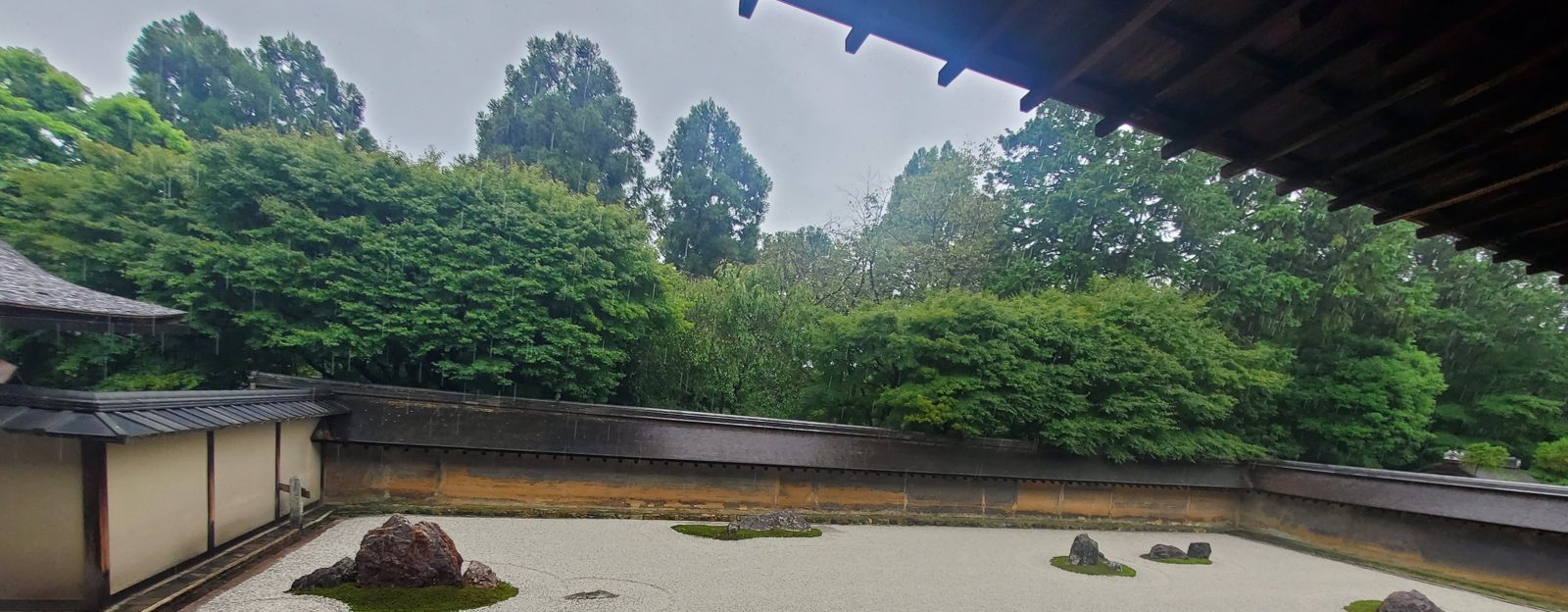
The rock garden spreading to the south of the Hojo is a karesansui (dry landscape) garden measuring about 25 meters wide and about 10 meters deep, with white gravel spread over a rectangular space and 15 stones of various sizes arranged within it. The 15 stones are arranged from east to west in five distinct groups of 5, 2, 3, 2, and 3 stones. Green moss is placed at the base of each stone, and broom lines imitating water ripples are neatly drawn in the white sand.
A prominent feature of this rock garden is that from any position along the veranda of the Hojo, at least one stone is hidden by another, making it impossible to see all 15 stones at once. The number "15" evokes the full moon (the fifteenth night) and is also said to represent completeness. There is also an interpretation that seeing one stone missing serves as a teaching to recognize one's own imperfections.
This arrangement is regarded as a physical embodiment of the Zen philosophy: "re-examine one's deficient self and appreciate one's present circumstances." The garden is also known by other names, such as "Tora no Ko Watashi" (Tiger Cubs Crossing the River), likening the stone clusters to a mother tiger carrying her cubs across a river, and "Shichi-Go-San no Niwa" (Garden of Seven, Five, and Three), derived from auspicious odd numbers. Visitors sit on the veranda and quietly face the composition of white sand and stones, from which all excess has been stripped away.
The Dry Landscape Shrouded in Mystery of Its Creator and Intent, and the Ingenuity of the Oil-Earth Wall
No clear records remain indicating the construction period or the creator of Ryoan-ji's rock garden. While there are various theories, such as attributing it to Soami, a painter of the Muromachi period, or suggesting the involvement of Kobori Enshu, a tea master and garden designer of the Edo period, no definitive historical documents have been discovered. On the back of a stone placed in the back of the garden, the names "Kotaro and Hikokuro" are carved, which are thought to be the names of the sansui kawaramono (craftsmen who engaged in garden making) who actually undertook the garden construction work.
The wall surrounding the south and west sides of the rock garden is called the "Yudobei" (oil-earth wall). It is a sturdy clay wall made by kneading and compacting red clay mixed with rapeseed oil and lime, topped with a tiled roof. The oil-earth wall prevents the glare of strong sunlight reflecting off the white sand, and over many years, the oil has seeped out to the surface, creating unique mottled patterns of light and dark.
A visual effect applying perspective is incorporated into the oil-earth wall. It is designed so that the wall becomes lower as it extends farther away from the Hojo compared to the foreground. In a limited space of about 75 tsubo, an advanced technique is employed to evoke a sense of depth and expansiveness.
The Tsukubai of "Ware Tada Taru wo Shiru," Said to Be Donated by Tokugawa Mitsukuni
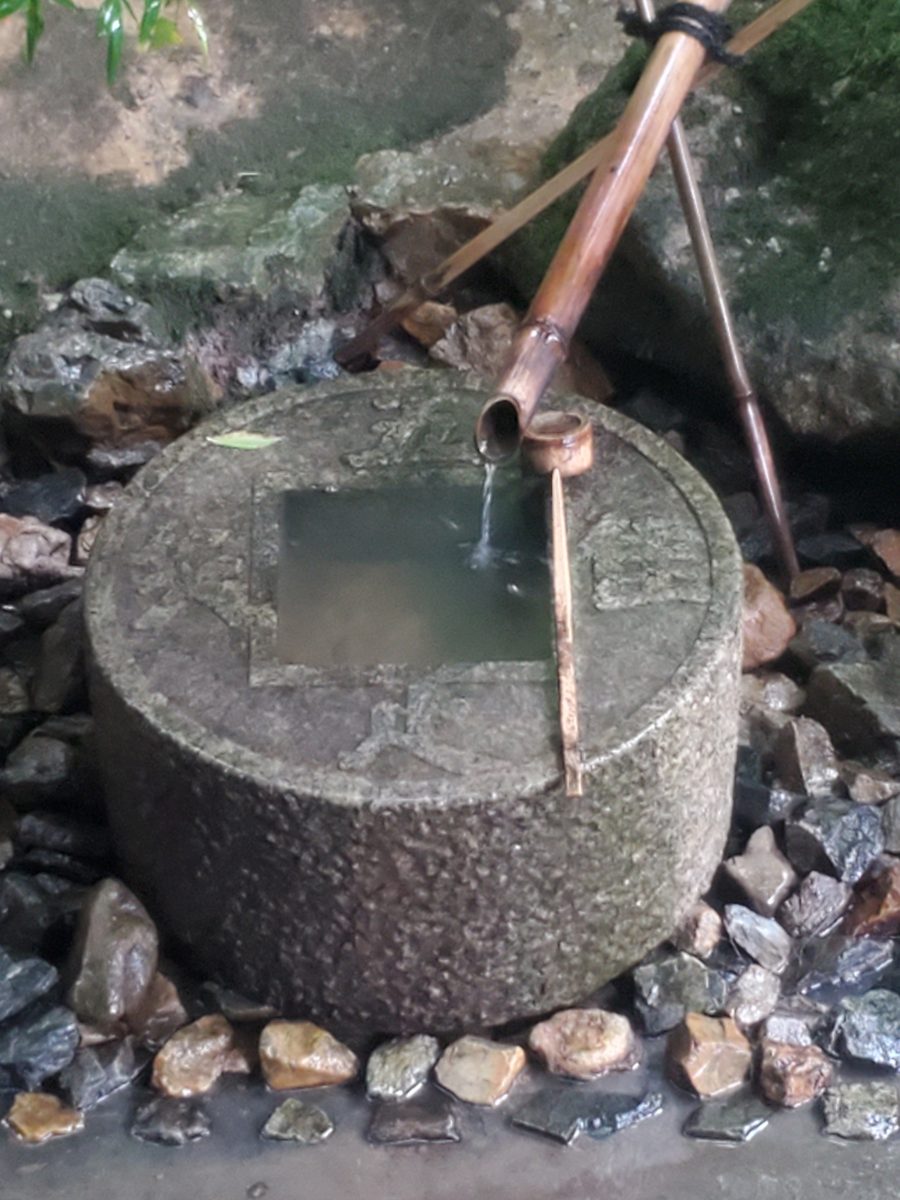
In the roji of the Zoroku-an teahouse, located to the northeast of the Hojo, a stone "tsukubai" (water basin) is placed. What is currently open to the public along the general viewing route is an elaborate replica set behind the Hojo. This tsukubai is traditionally said to have been donated by Tokugawa Mitsukuni, lord of the Mito Domain in the early Edo period, and is widely known alongside the rock garden as a historical remain that symbolizes the philosophy of Ryoan-ji.
A tsukubai is a water basin used to cleanse one's hands and mouth before entering a tea room. Ryoan-ji's tsukubai is in the shape of a round coin, with a square water hole in the center. Four characters—"五", "隹", "疋", and "矢"—are carved around the water hole. It is designed to be read by viewing the square water hole in the center as the kanji radical "口" (mouth) and sharing it with each of the characters.
When combining these four characters clockwise with "口", they become "吾", "唯", "足", and "知", reading "Ware tada taru wo shiru" (I learn only to be content). This design illustrates the teaching in the Butsu Yuikyogyo (The Sutra of the Buddha's Bequest) preached by Shakyamuni Buddha: "Those who know contentment, though poor, are rich; those who do not know contentment, though rich, are poor," demonstrating the essence of Zen: to be satisfied with the present state without harboring discontent.
Kyoyo-chi Pond and the History Inherited from the Tokudaiji Family's Villa to a Zen Temple
"Kyoyo-chi" (Mirror Pond), which spreads across the southern part of the temple grounds, is a pond that carries on the remains of a garden from a villa maintained by the aristocratic Tokudaiji family in the late Heian period, before Ryoan-ji became a Zen temple. In the past, aristocrats floated boats on this pond to enjoy song, dance, and music. Because many mandarin ducks gathered at the pond, it was also formerly called "Oshidori-ike" (Mandarin Duck Pond).
In 1450 (Hotoku 2), Hosokawa Katsumoto took over this mountain villa from the Tokudaiji family and founded Ryoan-ji with Giten Gensho of Myoshin-ji as its founding abbot. Although the various temple halls were burned down during the Onin War, the temple was revived in 1488 (Chokyo 2) by Katsumoto's son, Hosokawa Masamoto, and the rock garden is believed to have been built around this time. The temple has survived a long history of wars and reconstructions to reach the present day.
The stroll garden centered around Kyoyo-chi Pond displays a natural landscape in stark contrast to the rock garden composed solely of stones and white sand. Different expressions are reflected on the water's surface each season: cherry blossoms in spring, water lilies spreading across the water from early summer to summer, autumn foliage, and snowy landscapes in winter. On Benten Island in the center of the pond stands a torii gate, retaining the appearance of the former syncretism of Shinto and Buddhism.
Cultural Properties on Ryoan-ji's Grounds and Strolls Around the Surrounding Area
On the grounds of Ryoan-ji stands the Hojo, designated as an Important Cultural Property. It is a structure originally built in 1606 (Keicho 11) as the main hall of Saigen-in by Oda Nobukane, the younger brother of Oda Nobunaga, and relocated here after a fire in 1797 (Kansei 9). To the north of the Hojo is the renowned "Wabisuke Tsubaki" (Wabisuke camellia), said to have been praised by Toyotomi Hideyoshi, and it is cherished as a famous tree on the temple grounds.
The foot of Mount Kinugasa, where Ryoan-ji is located, is called "Kinukake-no-Michi" and is one of Kyoto's premier historical walking areas, with Ninna-ji to the west and Kinkaku-ji to the east. Alongside visiting Ryoan-ji, it is popular as a walking route for touring the famous surrounding temples. Admission hours, admission fees, and operational status for transportation access vary by season, so please check the official Ryoan-ji website for the latest information when planning your visit.
For Those Looking for a Place to Stay Around This Area
In the "Related Articles" section at the bottom of this page, there are links to accommodations in the same area and articles about the surrounding vicinity. Please take a look at them before deciding where to stay.