It is called the "Silver Pavilion," yet there is no silver anywhere. Many first-time visitors to Ginkaku-ji in Kyoto stop and wonder about that, especially if they have just seen the dazzling gold of Kinkaku-ji.
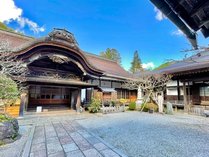
However, once you know this "reason why there is no silver," the dark wooden building begins to look far more interesting. The official name of Ginkaku-ji is "Higashiyama Jisho-ji." It is a Zen temple of the Rinzai sect's Shokoku-ji branch, originating from a mountain villa built by the 8th Muromachi shogun, Ashikaga Yoshimasa.
Why There Is No Silver Leaf on the Silver Pavilion: There Were Never Plans to Apply It
There have long been various theories as to why there is no silver leaf. "There was no money after the Onin War," "Yoshimasa passed away before it could be applied," or "It was applied in the past, but peeled and fell off." All of them sound plausible, but they are all mere folklore.
The answer emerged in 2007. In a scientific survey conducted before repair work, no silver was found on the exterior walls; instead, traces of black lacquer coating were discovered. In other words, the Silver Pavilion was a building that was never intended to be covered in silver from the start. What Yoshimasa aimed for was not the dazzling brilliance like Kinkaku, built by his grandfather Ashikaga Yoshimitsu, but a subdued "wabi" beauty.
Today, the bare wood is exposed and looks a bit weathered. But when it was first built, it must have been an exquisitely elegant building, glowing softly with black lacquer. I am sure of it.
"Ginkaku" Was a Nickname Given in the Edo Period
The official name of the building known as Ginkaku is "Kannon-den" (Kannon Hall), and it is a National Treasure. It is a two-story structure, with the first floor designed in a residential shoin style and the second floor built in the form of a Zen temple hall. At the top of the roof sits a phoenix, just like on Kinkaku. Although, looking up at it from below, it starts to look a little more like a chicken than a phoenix... let's keep that between us.
The name "Ginkaku" is not from the time Yoshimasa was alive. It is believed that it began being called that during the Edo period to pair it with Kinkaku (Rokuon-ji). Because the name became famous first, the mystery of "why there is no silver despite being called silver" was born.
The Sand Gardens Awaiting the Moon: "Ginshadan" and "Kogetsudai"
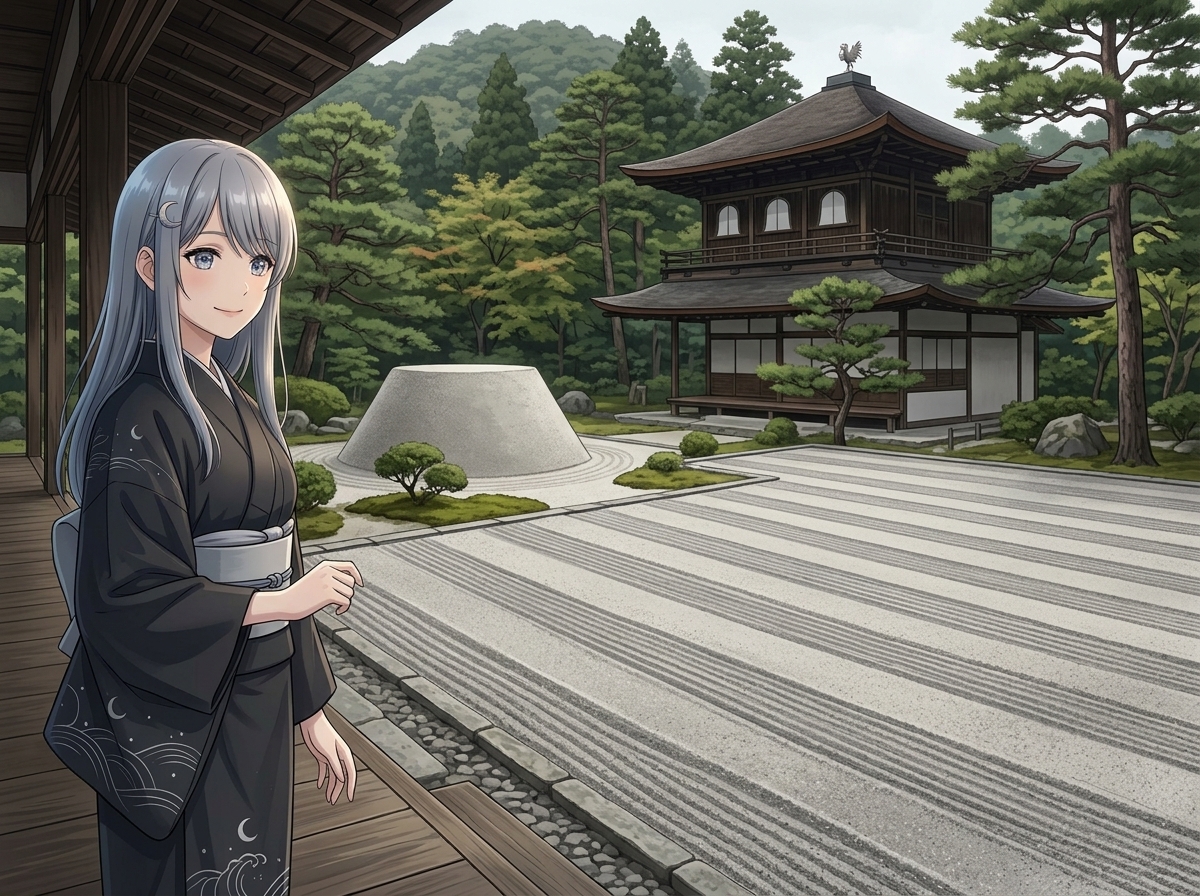
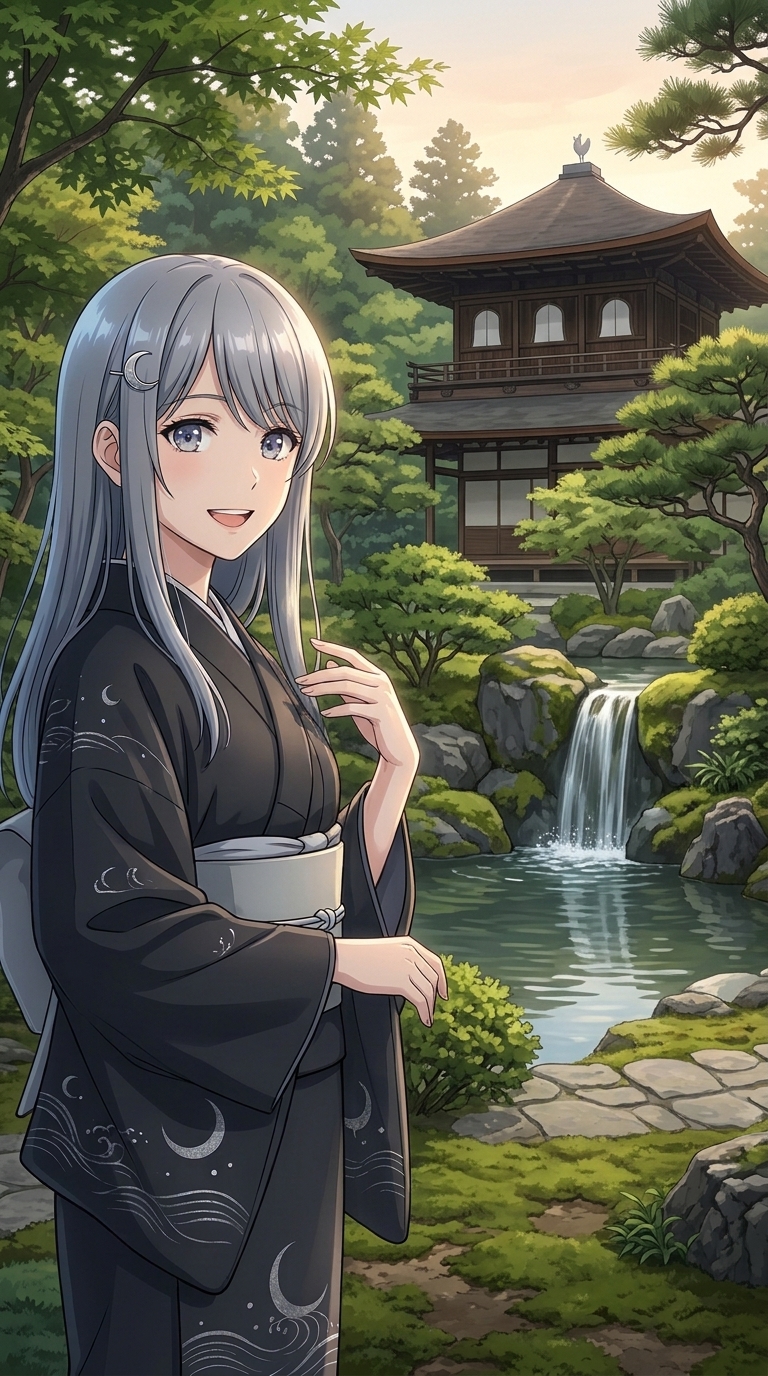
In front of the main hall are the "Ginshadan," where white sand is mounded like waves, and the "Kogetsudai," a sand mound shaped like a truncated cone. Legends say that "Ginshadan reflected the moonlight to illuminate the building" and that "people sat on Kogetsudai to await the moon rising from Higashiyama."
Of course, climbing onto Kogetsudai is not permitted today. If you sat on that neat conical shape, you would probably slide right off. Incidentally, these large sand sculptures did not exist when the temple was first built, but are believed to have been arranged into their current forms during the Edo period.
The garden is designed as a circular path around a pond and is designated as a national Special Historic Site and Special Place of Scenic Beauty. The latter half of the route becomes a path climbing the mountain slope, allowing you to look down on Ginkaku, the garden, and the cityscape of Kyoto from above.
The Roots of the Japanese-Style Room: "Togudo and Dojinsai"
Alongside Ginkaku, a building surviving from Yoshimasa's era is the National Treasure "Togudo." Completed in 1486, it was Yoshimasa's private Buddhist chapel.
Inside, the 4.5-tatami study called "Dojinsai" features a built-in desk (tsukeshoin) and staggered shelves (chigaidana), considered the prototypes for the tokonoma alcoves and shoin of modern Japanese-style rooms. The origins of what we perceive as "Japanese-style rooms" lie right here. A shogun's study only four and a half mats in size may sound surprising, but perhaps this was exactly the size where Yoshimasa felt most at ease. Togudo is usually closed to the public, but the interior can sometimes be viewed during special openings in spring and autumn.
Tips for Walking Through Ginkaku-ji
- From the Main Gate to the Middle Gate, the "Ginkaku-ji-gaki" approach continues for about 50m between bamboo fences and hedges. It is a pleasant path where outside noise seems to fade away.
- The temple grounds follow a one-way route. You will tour in the order of: Front of Main Hall → Ginshadan & Kogetsudai → Togudo → Pond → Mountain Path → Kannon-den.
- There are stone steps along the mountain path, so go in comfortable walking shoes.
- Visiting hours and admission fees are subject to change, so please check Ginkaku-ji's official information before visiting.
- The "Philosopher's Path" starts right nearby. Walking south will take you toward Honen-in and Nanzen-ji.
You can find nearby stays and more Kyoto stories in the related links at the bottom of this page. We hope they help you plan your trip.